


Connecting the connectors
Do not squander time – this is stuff life is made of
Connectors provide numerous advantages. They are modular and designed for reusability, allowing processes to communicate with any system or technology. These capabilities reduce the time required for modeling, implementation, and automation of business processes.
Among such connectors is the PostgreSQL Connector by Infosys. The connector provides a true low-code experience for individuals modeling business processes. To successfully launch a process, all you need is a SaaS or self-managed Camunda 8, a Spring Boot Application with the connector included in the dependencies. The rest of the tasks fall to the analyst.
Let me explain how the interaction mechanism between Zeebe and connectors works. Zeebe acts as a broker through which all instances pass. Each instance wants to be processed by the appropriate JobWorker. A JobWorker has its own type that identifies it, even if it is a connector. Connectors have their own static types, such as in our case, the PostgreSQL Connector with type=`com.infosys.camundaconnectors.db:postgresql:1`.
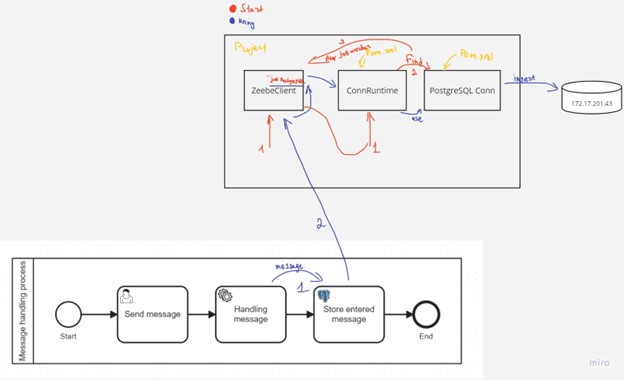
When we start the JobWorker, we signal the broker that the JobWorker is ready to process incoming instances. The broker directs all instances waiting for a JobWorker of a specific type to the one that is ready to work.
As a newcomer to working with Camunda 8, I have encountered problems primarily related to the lack of experience with connectors. I spent several valuable days on the initial deployment of the connector. However, after overcoming this challenging path, I can easily deploy it within minutes. The greatest luxury is the joy of understanding.
Connectors take care of implementing complex integration with the end system, allowing low-code developers to operate the connection at the level of ordinary business logic.